
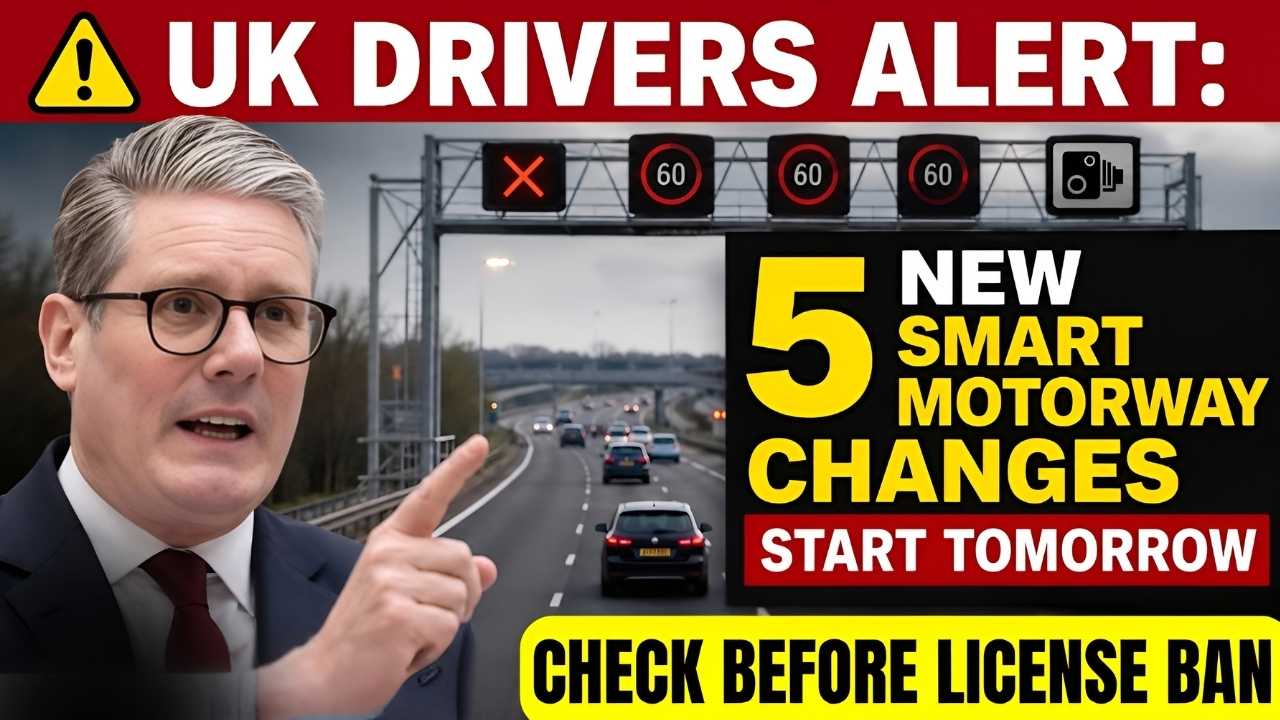
Millions of drivers across the United Kingdom are preparing for a major shift on the roads as new smart motorway changes officially begin tomorrow. These updates are part of the government’s latest road safety and traffic management strategy for 2026. Whether you travel daily for work, drive long distances for business, or simply use motorways occasionally, these changes could affect your journey in several important ways.
Over the past few years, smart motorways have sparked debate among drivers, road safety experts, and transport authorities. Some motorists praised the technology for reducing congestion, while others raised concerns about safety and emergency response times. In response, officials have introduced a fresh set of motorway rules and upgrades designed to improve both safety and traffic flow.
From updated speed enforcement systems to new emergency lane policies, the changes are expected to impact drivers almost immediately. Understanding these new rules before your next journey could help you avoid fines, stay safe, and drive with greater confidence.
New Emergency Refuge Areas Will Be Added More Frequently
One of the biggest changes starting tomorrow is the increase in emergency refuge areas on smart motorways across England. Drivers have long complained that refuge bays were too far apart, especially on all lane running motorways where the hard shoulder operates as a live traffic lane.
Under the new 2026 plan, emergency stopping areas will now appear at much shorter intervals. This means drivers who experience breakdowns or vehicle trouble should have quicker access to a safe stopping point.
Transport officials believe this update will significantly reduce the risks faced by stranded motorists. New high visibility signs and road markings are also being introduced to make these areas easier to spot, particularly at night or during poor weather conditions.
Drivers are being reminded that emergency refuge areas are only for genuine emergencies. Stopping unnecessarily could still lead to penalties or enforcement action.
Smarter Speed Cameras Will Monitor Traffic More Closely
Another major change involves upgraded speed camera systems across several UK motorways. The latest smart camera technology will now monitor average speeds more accurately and detect lane misuse in real time.
Authorities say the goal is not simply to issue more fines but to encourage safer and smoother driving behaviour. Variable speed limits will continue to operate during busy periods, accidents, or roadworks, but the updated system will respond faster to changing traffic conditions.
Motorists who ignore temporary speed limits may face automatic penalties without warning. The cameras are now capable of detecting speeding across multiple lanes simultaneously, even in heavy traffic.

Officials also confirmed that mobile phone use behind the wheel and dangerous lane switching could become easier to detect using advanced AI supported monitoring systems installed on selected motorway sections.
Drivers are advised to pay close attention to overhead gantry signs because speed limits may change more dynamically than before.
Red X Lane Rules Will Become Stricter
The Red X lane closure rule is already familiar to many UK motorists, but from tomorrow enforcement will become much stricter. Drivers who ignore a Red X sign and continue using a closed lane could face larger fines and additional penalty points.
The Red X is used to indicate that a lane is closed due to an accident, breakdown, roadworks, or emergency services activity. Despite repeated warnings over recent years, many drivers still fail to comply, creating serious risks for stranded motorists and highway workers.
Under the updated motorway regulations, authorities will use enhanced camera enforcement to catch offenders more consistently. Some regions are expected to implement near instant detection systems linked directly to penalty processing centres.
Road safety groups have welcomed the tougher approach, arguing that lane closure violations remain one of the most dangerous behaviours on smart motorways.
Experts say drivers should never assume a closed lane is safe simply because they cannot immediately see the reason for the closure. Hazards may be located further ahead beyond bends or heavy traffic.
Breakdown Detection Technology Is Being Expanded
One of the most important safety improvements arriving in 2026 is the wider rollout of stopped vehicle detection systems. These advanced radar based technologies are designed to identify stationary vehicles on live motorway lanes within seconds.
Once a stopped vehicle is detected, traffic officers can quickly activate warning signs, lower speed limits, and close affected lanes to protect drivers and passengers.
In the past, delays in detecting breakdowns were heavily criticised by campaigners and road safety experts. Officials now claim the upgraded technology can dramatically improve response times.

Drivers who break down on a smart motorway are still advised to follow official guidance carefully. If possible, motorists should attempt to reach an emergency refuge area. If that is not possible, passengers should exit the vehicle safely and move behind roadside barriers while emergency assistance is contacted.
Authorities hope the faster detection systems will reduce panic among drivers who may feel vulnerable during motorway breakdown situations.
New Driver Awareness Campaign Launches Nationwide
Alongside the physical motorway upgrades, a major nationwide awareness campaign is launching tomorrow to educate drivers about the latest rules and motorway safety practices.
The campaign will appear across television, radio, social media, and motorway service stations. Officials believe many drivers still lack confidence when using smart motorways, especially during emergencies or lane closures.
Educational materials will focus on topics such as understanding variable speed limits, responding to Red X signs, using emergency refuge areas correctly, and handling vehicle breakdowns safely.
Driving instructors and motoring organisations are also expected to play a larger role in helping motorists adapt to the changes. Some experts have even suggested that future driving tests may include more detailed smart motorway safety questions.
The campaign aims to reduce confusion while encouraging safer and more responsible motorway driving habits throughout the country.
Why These Changes Matter for Everyday Drivers
For regular motorway users, these updates could have a noticeable impact on daily travel. While some drivers may initially feel frustrated by stricter enforcement and additional monitoring, officials insist the long term benefits will include improved traffic flow and better safety outcomes.
Congestion remains one of the UK’s biggest transport challenges, especially during peak commuting hours. Smart motorways were originally introduced to increase road capacity without building entirely new roads. However, public confidence declined after several high profile incidents raised concerns about driver safety.
The 2026 changes represent an effort to rebuild trust while improving motorway efficiency through modern technology and clearer enforcement.

Drivers who stay informed and follow the updated rules are unlikely to experience major problems. In fact, many road users may benefit from smoother traffic movement and quicker incident response times over the coming years.
What Drivers Should Do Before Their Next Journey
Before setting off on a motorway journey tomorrow or later this week, drivers should take a few simple precautions. Checking vehicle condition is more important than ever, particularly tyre pressure, fuel levels, battery health, and engine performance.
Motorists should also familiarise themselves with smart motorway signs and understand how variable speed limits operate. Paying attention to overhead gantries and avoiding distractions while driving can help reduce the risk of penalties or accidents.
Experts recommend planning journeys carefully during busy travel periods and allowing extra time where possible. Drivers should remain patient during changing speed limits because sudden traffic management measures are often introduced to prevent accidents further ahead.
Understanding how to react during a breakdown could also make a critical difference in an emergency situation.
Final Thoughts on the 2026 Smart Motorway Changes
The UK’s latest smart motorway updates mark one of the biggest motorway policy shifts in recent years. While opinions on smart motorways continue to vary, tomorrow’s changes clearly signal a stronger focus on safety, enforcement, and technology driven traffic management.
For drivers, the key to adapting successfully will be awareness and preparation. The roads themselves may not look dramatically different overnight, but the systems monitoring traffic and enforcing rules will become more advanced and far more responsive.
By staying alert, following motorway signage carefully, and understanding the updated regulations, drivers can avoid fines, reduce stress, and travel more safely across the UK’s motorway network in 2026.
The next few months will likely reveal whether these changes deliver the improvements authorities are promising. Until then, motorists are being encouraged to drive cautiously, remain informed, and treat every smart motorway journey with extra attention and care.